
In the centralized AI model, access, service pricing, and request processing depend on the provider, while the quality of the output is often difficult to verify. DGrid AI aims to address this issue through a distributed computing network, a verification mechanism, and on-chain payments. What makes DGrid AI stand out? Let’s explore it in the article below.
What Is DGrid AI?
DGrid AI is a decentralized AI inference network that brings model providers, node operators, developers, and users together within a single infrastructure. The project’s architecture includes a routing and verification network, a marketplace for models and AI agents, and an AI DAO governance system.
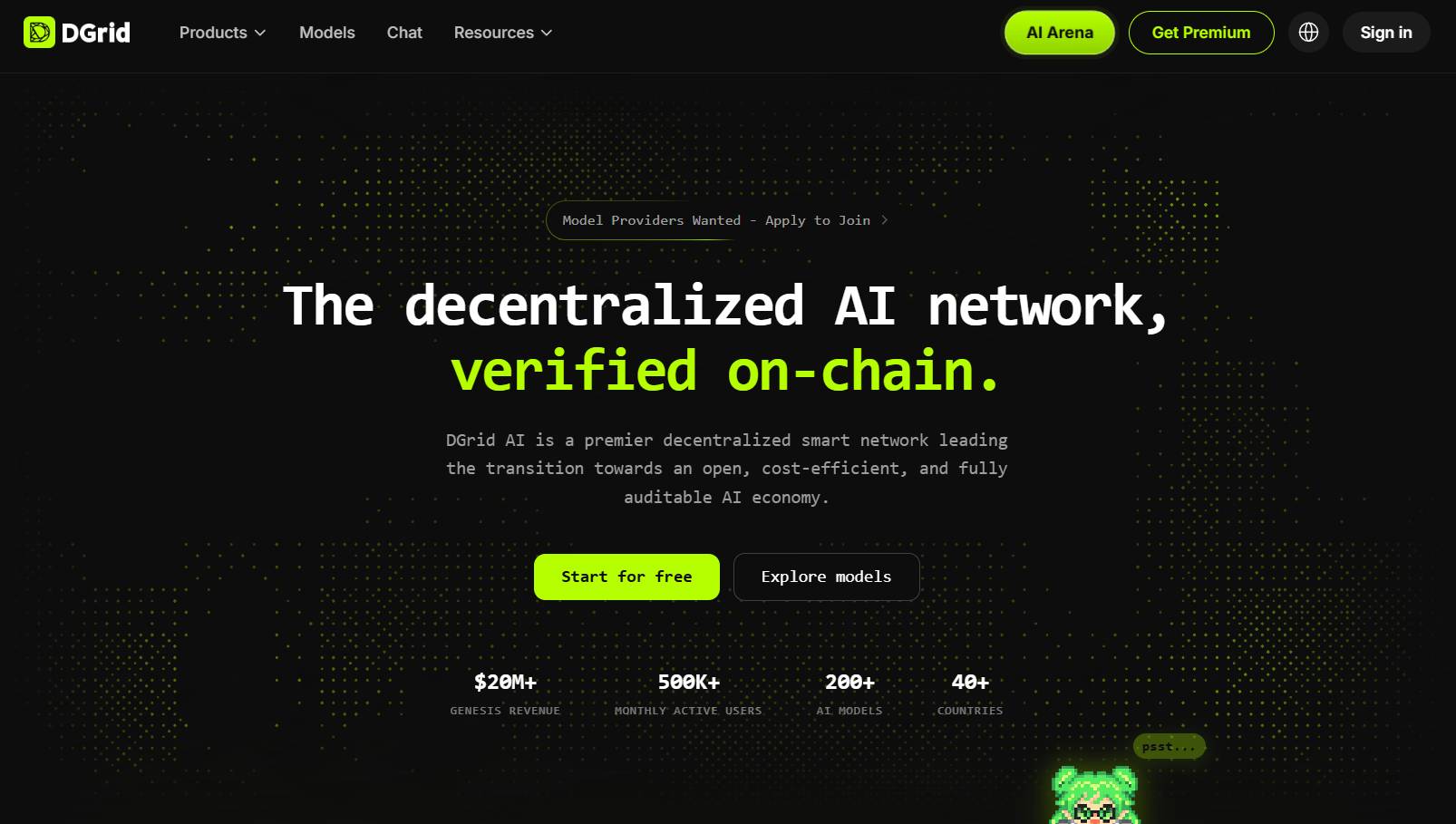
DGrid AI Homepage
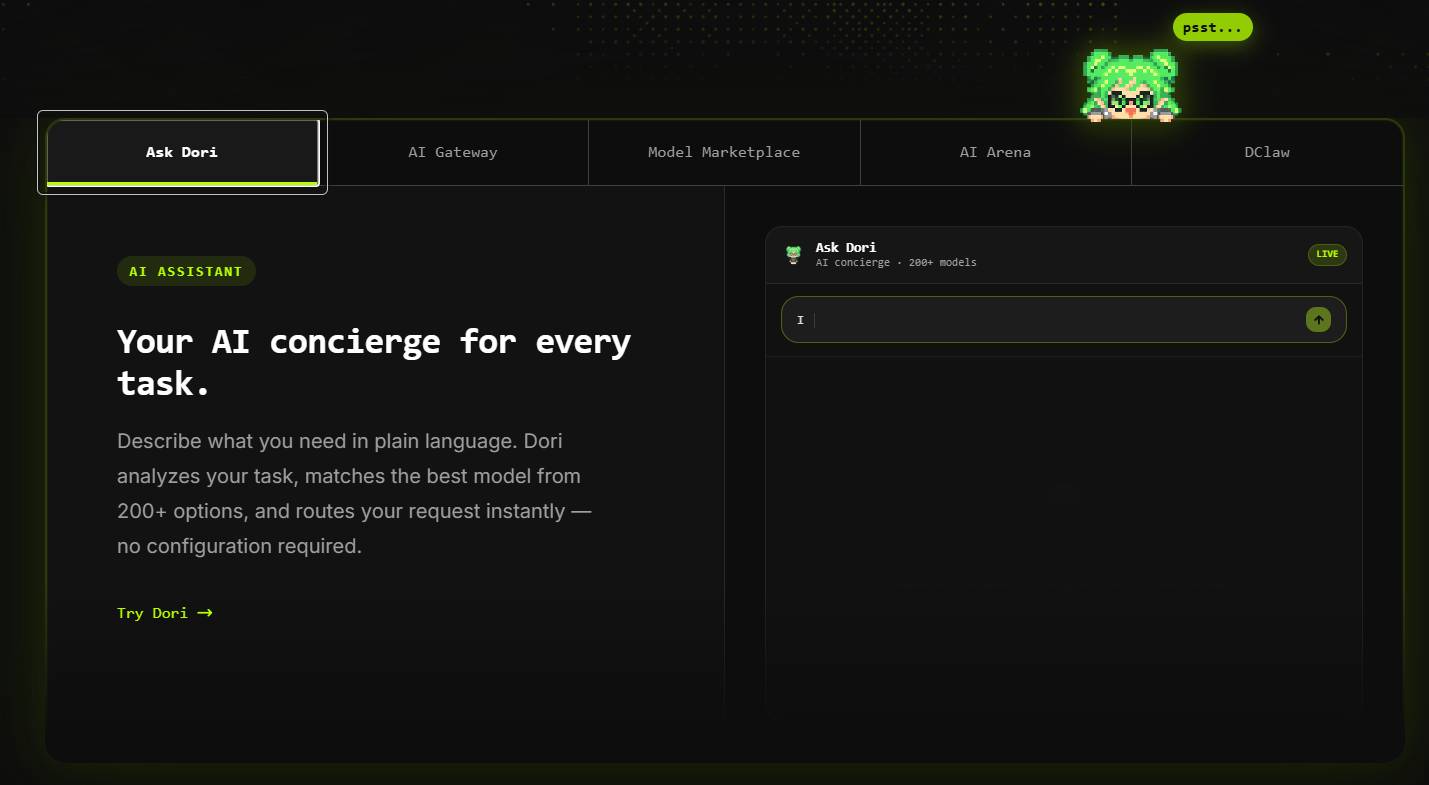
The project’s core product is DGrid AI Gateway, an API compatible with the OpenAI format that gives developers access to more than 200 AI models. The ecosystem also includes AI Arena for collecting community evaluations, Dori for model discovery, and DClaw for deploying AI agents.
DGrid positions itself as an intermediary layer between demand for AI services and distributed computing resources. Instead of integrating each provider separately, applications can send requests through the Gateway, after which the system selects the most suitable model or node.
Key Features of DGrid AI
The main distinction in DGrid AI’s design is the combination of request routing with an output quality assessment mechanism. The network does not simply forward a request to one fixed provider. It can select a model and node based on the type of task, budget, latency, resource availability, and historical performance data.
Proof of Quality
Proof of Quality, or PoQ, is a mechanism proposed by DGrid for evaluating AI inference results. Outputs may be scored according to their similarity to a reference result, consistency across nodes, and ability to comply with the format requested by the user.
The system may also use semantic similarity and execution cost to balance output quality against resource consumption. After completing a task, a node submits logs and quality data that can be used to create evidence for subsequent verification.
PoQ creates a workflow that includes request submission, execution, evaluation, and settlement. The mechanism is intended to help users verify the quality of a result without having to rerun the entire inference process themselves.
However, the practical effectiveness of PoQ depends on how evaluators are selected, the quality of reference data, consensus thresholds, and the system’s ability to limit collusion between nodes. DGrid AI has not yet disclosed all of these parameters in its user-facing documentation.
Hybrid On-Chain and Off-Chain Architecture
DGrid AI does not run the entire inference process directly on the blockchain. Model execution, data processing, and request routing mainly take place off-chain to maintain fast response times.
The blockchain is used for activities such as signature verification, payments, staking, penalties for nodes, governance, and recording data required for audits. This creates a hybrid architecture in which the off-chain layer handles performance, while the on-chain layer is responsible for settlement and verification.
The network’s level of decentralization will depend on the number of independent nodes, the way evaluators are selected, and the extent to which smart contracts are deployed. At present, DGrid AI has not provided contract addresses or complete network data that would allow users to independently verify the full architecture.
DGrid AI Architecture and How It Works
The process of handling an AI inference request on DGrid AI is described as follows:
-
Request submission. A user or application sends a request through DGrid AI Gateway. The API is compatible with the OpenAI format, allowing developers to migrate by changing the
baseURLand API key. -
Authentication and payment. The Gateway checks access permissions. DGrid’s technical documentation also refers to EIP-712 signatures and the x402 protocol for authentication and payment on a per-request basis.
-
Off-chain routing. The system selects a model or node based on the task type, resource availability, cost, latency, and historical performance data. This process takes place off-chain to preserve response speed.
-
Inference execution. A DGrid Node runs a large language model or AI agent on a GPU supplied by the operator. The node processes the input and reports metrics such as Compute Units, latency, and uptime.
-
Proof of Quality evaluation. The result is scored based on relative accuracy, consistency, and format compliance. DGrid describes this as a hybrid verification architecture, although it has not yet fully disclosed how evaluators are selected.
-
On-chain settlement. The Bill Contract is designed to hold the payment, calculate fees based on resource usage and latency, and then distribute DGAI to the node and other relevant participants.
-
Rewards or penalties. Nodes that operate reliably may receive rewards. Nodes that provide incorrect results or remain offline beyond an allowed threshold may lose part of their staked DGAI or be temporarily suspended from the network.
The architecture includes both products that already have working interfaces and components that remain on the roadmap. AI Gateway and AI Arena have already been launched, while AI DAO, Agent Launchpad, and Model & Agent Market are planned for development in the third and fourth quarters of 2026.
DGrid AI Features
DGrid AI Gateway
Provides a single API for accessing more than 200 AI models. Compatibility with the OpenAI SDK allows developers to avoid rewriting the entire integration layer when switching models.
Free Models Router
Allows users to specify the model ID dgridai/free, after which the system automatically selects an available free inference resource. Because the model may change between requests, this mode is not suitable for applications that require a fixed provider.
Proof of Quality
Evaluates inference results using multiple criteria and generates data that can be used to verify output quality.
DGrid Nodes
Allows operators to contribute GPUs, deploy models or AI agents, and receive rewards based on usage volume, latency, and uptime.
AI Arena
Displays two anonymous responses and asks users to select the better result. The votes are used as a model evaluation signal. The project states that accumulated points may influence the allocation of the DGAI airdrop at the token generation event.
Dori
A natural-language model discovery tool that helps users compare available options based on capabilities, pricing, and benchmark results.
DClaw
An AI agent deployment layer built on CoPaw. It combines model access, long-term memory, communication channels, and the skills required by an agent.
Model Marketplace
A catalogue that allows users to explore the models available through AI Gateway. A version that enables providers to list models and AI agents, set prices, and earn revenue remains part of the project’s roadmap.
Genesis Premium
A membership programme that includes the Genesis Pass NFT, access to resources, and a reward mechanism subject to the project’s terms. DGrid states that the programme is offered under Regulation S, is unavailable to U.S. persons, and includes a 12-month transfer restriction. This does not mean that the project has been approved or licensed by a regulator.
DGAI Token Information
Basic DGAI Token Details
| Parameter | Value |
|---|---|
| Project Name | DGrid AI |
| Ticker | DGAI |
| Blockchain | To be announced |
| Total Supply | 1,000,000,000 DGAI |
| Circulating Supply | To be announced |
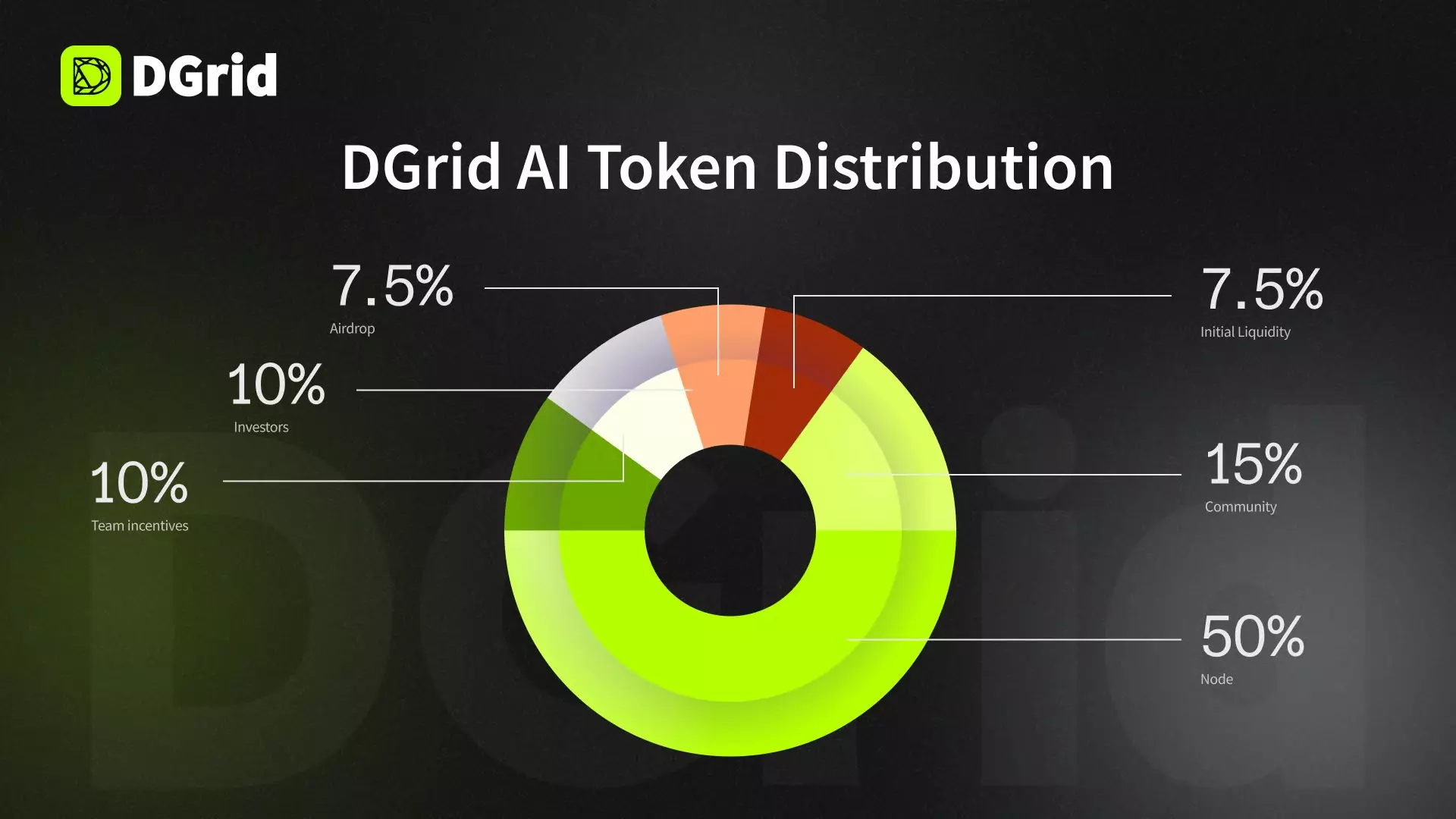
DGAI Token Allocation
-
Node rewards — 50%
-
Community — 15%
-
Team incentives — 10%
-
Investors — 10%
-
Airdrop — 7.5%
-
Initial liquidity — 7.5%
DGAI Token Utility
-
Staking. Nodes and AI service providers stake DGAI to gain access to traffic, build reputation, and use the token as collateral for network operations.
-
Payments. DGAI is designed to pay for inference and AI agent services within the ecosystem.
-
Incentives. Nodes may receive DGAI based on processing volume, latency, uptime, and quality evaluation results.
-
Governance. Staked DGAI is used to vote on proposals related to fee schedules, supported models, protocol upgrades, and treasury allocation.
-
Penalties. A portion of the DGAI staked by a node that violates network rules may be confiscated and burned under the mechanism described by the project.
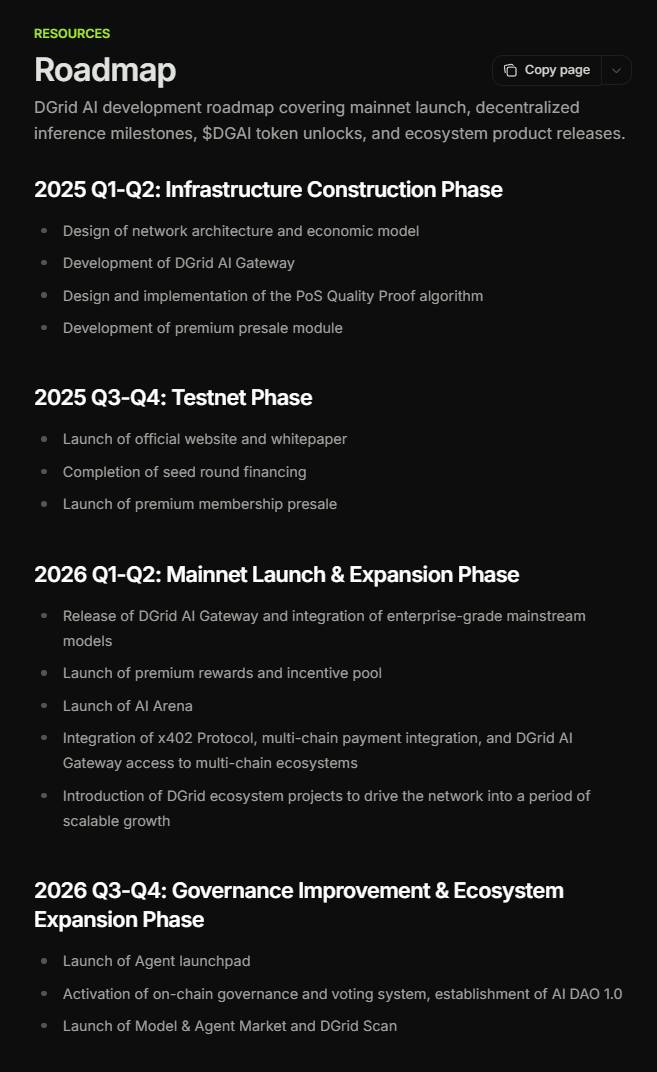
DGrid AI Roadmap
-
Q1–Q2 2025: Design of the network architecture and economic model, development of DGrid AI Gateway, the quality assessment algorithm, and the Premium module.
-
Q3–Q4 2025: Launch of the website and whitepaper, completion of the seed funding round, and launch of Premium membership sales.
-
Q1–Q2 2026: Launch of AI Gateway, AI Arena, and the Premium rewards mechanism, integration of popular AI models, the x402 protocol, and multi-chain payments.
-
Q3–Q4 2026: Planned launch of Agent Launchpad, on-chain governance, AI DAO 1.0, Model & Agent Market, and DGrid Scan.
The project’s roadmap places the mainnet launch in Q1–Q2 2026. However, DGrid AI has not yet published a network explorer or contract addresses that would allow users to verify the actual status of the mainnet.
DGrid AI Team
At present, DGrid AI has not disclosed complete information about the project’s development team. Coin68 will update the article when more details become available.
DGrid AI Investors and Funding
DGrid AI’s funding history includes two references to seed financing. In October 2025, the project raised an undisclosed amount from Waterdrip Capital, IoTeX, Paramita, CatcherVC, 4EVER Research, and Zenith Capital VC.
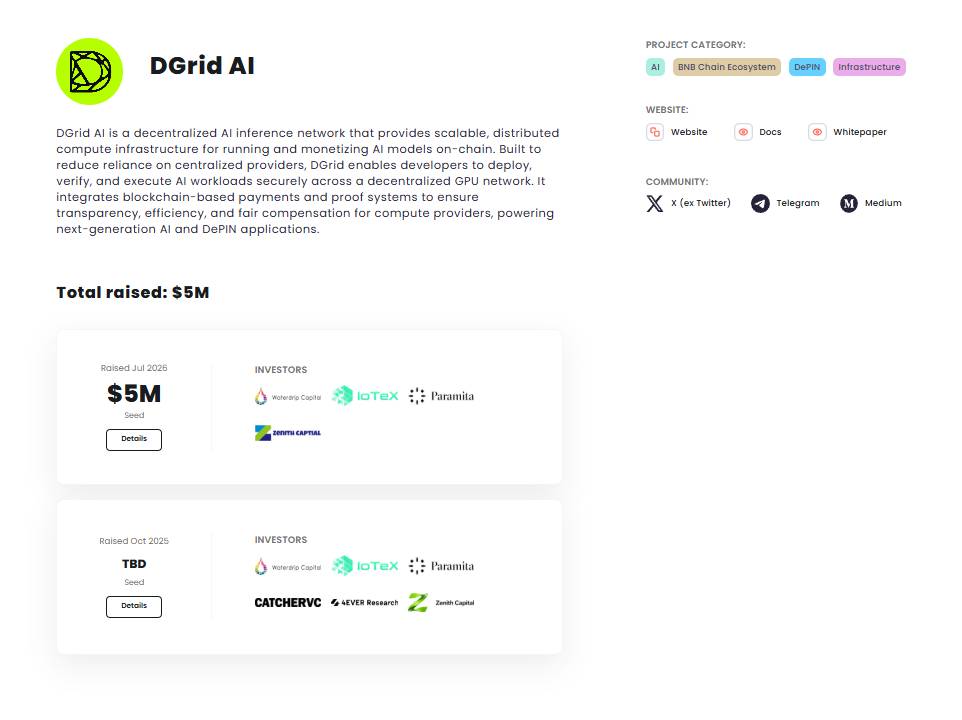
In July 2026, DGrid AI announced that it had raised USD 5 million from a group of investors, some of whom had already appeared in the earlier announcement. It remains unclear whether this was a new round or an update to the previous financing, so the project’s total funding cannot yet be determined.
Conclusion: DGrid AI presents an interesting model that combines distributed computing, AI output verification, and on-chain settlement. However, the project has not yet disclosed contract addresses, complete mainnet data, or the detailed parameters of Proof of Quality, making it too early to assess the network’s actual level of decentralization and the long-term sustainability of the DGAI token economy.